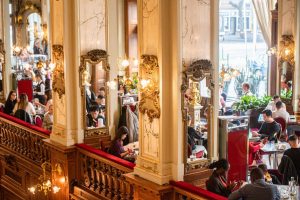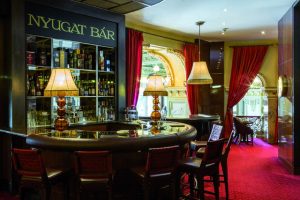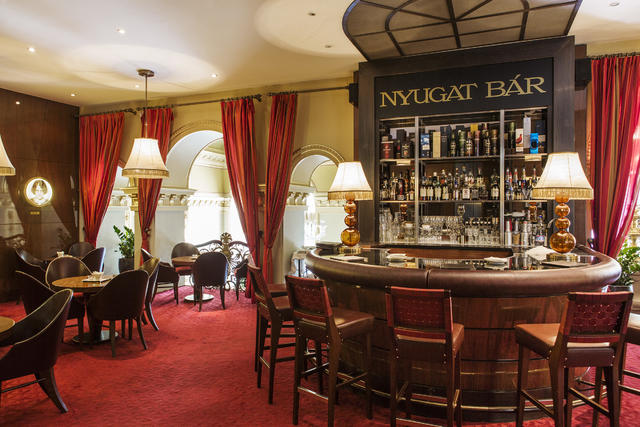
The upstairs bar, bathed in soft lighting, is one of the most pleasant spaces in the New York Palace. From here, you can look out over the Salon Restaurant, part of the New York Café, and the hotel lobby; it’s a lovely spot to take in the view, have a coffee, enjoy a good lunch or dinner, and savour the piano music and the attentive service. However, the Nyugat Bar has endured a great many trials and tribulations to achieve this tranquillity; its trials began as far back as the last century.
Although the New York Palace was not primarily built as a café – it was originally the headquarters of the New York Life Insurance Company – it soon became an important venue for public life. The café area was set up on the ground floor, whilst the insurance company’s offices were located on the upper floor.
As it turned out, cultural public life needed a central venue. Nothing demonstrated this need more clearly than the fact that the cream of the literary and artistic world of the time practically flocked to the grand opening held on 23 October 1894. The New York had, quite unwittingly, become a literary café.
The aim: to impress
Whilst other cafés were converted from existing buildings, the New York Café was designed for this purpose from the outset. The building was constructed with the clear aim of representing the insurance company in a fitting manner – that is, to impress those entering the building. This is precisely why the décor was more opulent than usual and the design more sophisticated; the café became the building’s main attraction, its purpose being to dazzle visitors and demonstrate the company’s boundless wealth. This was an unqualified success. Anyone who attended the opening – or read the reports on the opening and subsequent descriptions – would have found them all using superlatives to praise the unrivalled opulence and sophistication of the interior.
The Birth of the Bar
In 1918, Miksa Aczél and his partners took over the management of the café. They carried out a number of controversial alterations, which were criticised mainly by figures from the art and press worlds. A restaurant was established in the ‘deep water’ area, where the billiards room had been, whilst the rooms behind the upper balcony were converted into a bar. This did not yet make a lasting impression on the guests, but the refurbishment carried out a few years later even gave this cosy nook a name: it became the Mahagóni Bar.
An exclusive venue for nightlife
In the autumn of 1927, major architectural alterations were carried out, and the enlarged restaurant was opened to great acclaim. In 1928, the mahogany bar won the public’s affection and admiration. This was situated symmetrically opposite the marble hall, on the other side of the entrance on Miksa Street. Guests spoke enthusiastically of the unique lighting effects, the hidden play of light, and the alabaster columns glowing with a soft, opalescent light. The exclusive bar soon became the centre of Pest’s nightlife, attracting world-famous guests.
Five years later, changes were made once again: the bar’s décor was replaced, and booths and private boxes were installed; it welcomed Pest’s artistic community with writing desks and furniture suitable for playing rummy.
The New York Színész Páholy (Actors’ Circle)
Coffee-house life suffered during both the First and Second World Wars, but the final blow came to the New York when, in the 1950s – albeit only for a short time – the coffee-house section was converted into a sports shop. The café, renamed the Hungária, rose from the ashes in 1954. However, the New York’s true revival was still to come, at least until the fall of communism.