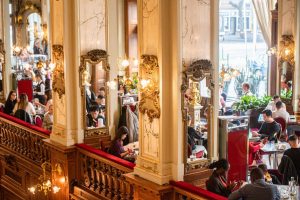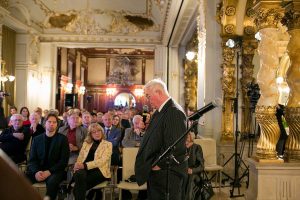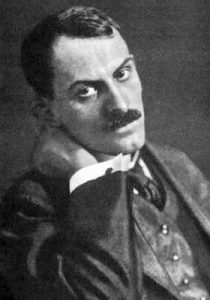
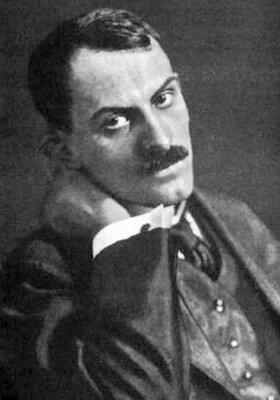
He was the leading figure of literature, its true guiding light, whilst at the same time becoming a bogeyman to poets, writers and his students. There is ample evidence of his immense erudition, talent and seriousness; and as editor-in-chief of *Nyugat*, he shaped destinies and determined fates. It was not exactly a desire for debauchery that drove him to the New York Café, but rather his editorial work.
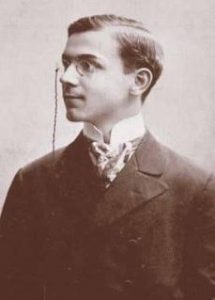
He was born in Szekszárd on 26 November 1883. He was a poet, writer, literary historian, academician, literary translator and a leading figure in early 20th-century Hungarian literature, as well as a member of the first generation of the *Nyugat* literary circle.
After passing his school-leaving examinations, he enrolled on the Hungarian-French programme at the University of Budapest, but ultimately chose to study Latin. He studied languages, aesthetics and philosophy, and took an interest in modern foreign literature; his extraordinary erudition was recognised even by his lecturers. During his university years, he formed lifelong friendships with Gyula Juhász, Dezső Kosztolányi and Gábor Oláh. After graduating, he taught in the provinces; in 1911, he took up a post as a grammar school teacher in Újpest. Together with Gyula Juhász, Dezső Kosztolányi and Árpád Tóth, he founded a small self-education circle; they would become the new generation that soon rose to prominence, and within a short time they were joined by the poets from Nagyvárad: Endre Ady, Lajos Bíró and Endre Nagy. Pál Ignotus took notice of his poems and literary translations, which had been appearing since 1902; consequently, from the launch of *Nyugat* in 1908, he became a contributor, then an editor from 1916, and eventually its editor-in-chief.
Babits’s works also contributed to shaping the ethos of *Nyugat*. Standards were high from the very beginning: Ernő Osvát was a key editor alongside Ignotus as editor-in-chief, and later became editor-in-chief of the journal himself; he was legendary for the commitment to quality he embodied. Osvát left a lasting legacy by discovering talent for the magazine one after another, and through his advice and meticulous editing of the texts, he ensured that even the very best authors had their most demanding works published. When Osvát died in 1929, Zsigmond Móricz and Mihály Babits jointly edited *Nyugat* for a short while, after which, from 1933, Babits became the magazine’s sole editor-in-chief; the publication ceased publication in 1941 upon the poet’s death.
As editor-in-chief, he was a man of extraordinary character. His colleagues often used metaphors such as „teacher” or ”instructor„ to describe him, but they also regarded him as a judgemental judge. According to Zoltán Zelk, Babits was a lighthouse on a small island braving the waves of the stormy sea, whilst Miklós Radnóti called him the ”living Standard’. The stability of Babits’s position was fundamentally linked to his conservative attitude towards literature and public life; yet *Nyugat* kept its distance not only from the avant-garde but also from the equally conservative populist-nationalist voice, displaying a kind of measured openness towards the ‘new songs of the new age’.
The journal published the bulk of his body of work: some two hundred poems, three novels, twenty short stories, his plays, over a hundred articles and essays, and fifty translations; he also edited a series of reviews entitled *Könyvrőlkönyvre* (*Book by Book*).
The influence of classical culture is evident in his early works; the conservative aspects of his outlook related chiefly to the preservation of cultural values. In 1911, he embarked on his greatest work of literary translation, rendering Dante’s *Divine Comedy* into Hungarian. His other significant literary translations include *The Tempest* by Shakespeare, *The Flowers of Evil* by Baudelaire (in collaboration with Lőrinc Szabó and Árpád Tóth), *Oedipus Rex* by Sophocles, and the collection *Erato*.
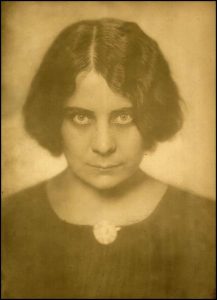
Following the death of Endre Ady, he became involved in a romantic relationship with the poet’s widow, Berta Boncza, née Ady; however, he eventually married Ilona Tanner in 1921, a writer known as Sophie Török. They had no children of their own, but adopted Ildikó, the young daughter of Sophie’s younger brother.
Following the outbreak of the World War, he was suspended from his teaching post because of his pacifist views. He was an enthusiastic supporter of the Aster Revolution; during the period of the proletarian dictatorship, he taught at the University of Budapest, for which he was later stripped of his chair and had his pension withdrawn.
In 1927, his most significant novel, the autobiographically inspired *The Sons of Death*, was published. A year later, he published his essay *The Betrayal of the Intellectuals* in *Nyugat*, in which he responded to Julien Benda’s book of the same title (1927). The piece, which lambasted the intellectual class for its lack of responsibility, caused a huge stir. He was later elected a member of the Kisfaludy Society and subsequently became a trustee of the Baumgarten Foundation.
As a magazine editor, he was keen to publish the works of folk poets and young writers, but he was averse to socialists and to overt, unambiguous politicking.In April 1937, he was diagnosed with laryngeal stenosis caused by a tumour. His symbolic narrative poem on a biblical theme, *The Book of Jonah*, published in 1940, summarises his personal and artistic development. In March 1941, he still delivered his inaugural lecture at the Academy, but thereafter he became almost completely unable to speak; he died in Budapest on the night of 4 August 1941.
After his death, the authorities did not permit the publication of *Nyugat*, as the publishing licence was in his name. The magazine’s staff, who had already dedicated a special issue to his work back in 1924, paid their last respects to him in the *Babits Memorial Book* (1941), edited by Gyula Illyés.
Alongside his work, which demanded a strict and serious lifestyle, he loved to read: he was a fan of crime novels, yet he also took pleasure in reading erotic works that bordered on the pornographic; he was an admirer of Bartók, enjoyed having a beer with the critics of *Nyugat*, including Aladár Schöpflin; he delighted in playing with his daughter Ildikó; and in his spare time he went skiing and sunbathing.