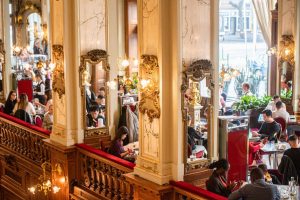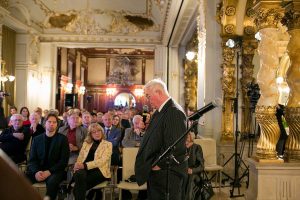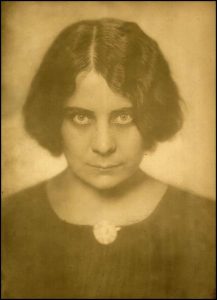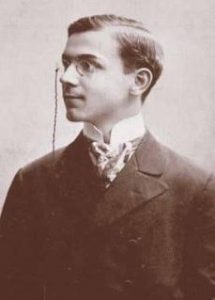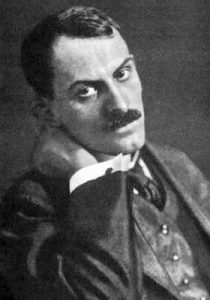
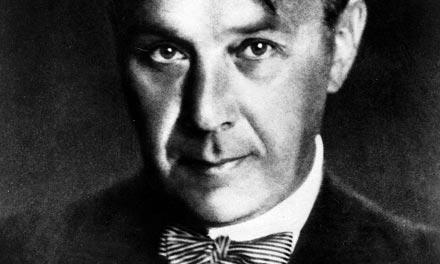
Dezső Kosztolányi (1885–1936) was one of the most outstanding artists of his time: a writer, poet, literary translator, critic, essayist, journalist and a leading figure of the first generation of the *Nyugat* literary circle. We can evoke the café’s historical past through the following poems and quotations. We can experience the unique atmosphere of the era and, through Kosztolányi’s eyes, come to understand this sense of privilege and inner conflict at the same time. Youth now gone by: plans for the future, debates and dreams, and the discussion of ideas.
Dezső Kosztolányi: A Séance at the New York Café
The steam from the coffee swirls and drifts through the mist of a winter’s morning, and there, where we once devoured on an empty stomach glory, tobacco and black coffee, amidst women and electric lights, raging raw, I sense the impossible itself, whimsy, adventure, my many old poems and the wild scent of aether from my youth. See, you could come now, Osvát. Perhaps death might even let you go; appear at this rendezvous, shine forth from behind the Baroque column, let me see them once more, in my forever wounded mourning, long-vanished, shining spectre, your commanding, enormous spectacles.Dezső Kosztolányi: Kornél Esti (excerpt)
„The café was buzzing; the noise in the gallery grew ever louder. Amidst this raucous clamour, they felt the rhythm of their lives, the sense that they were heading somewhere, that they were moving forward. Every table, every booth was taken. Storm clouds of smoke towered above. It felt good to stretch out in this vapour, in this warm pool, thinking of nothing, just listening to the bubbling and gurgling…”New York, you café where I spent so much time
New York, you café where I spent so much time,
let me open your door; perhaps I may still sit down,
though only like a beggar resting on the kerb,
and see what remains of me and of my surroundings.
On this early summer evening, whilst everyone is still having supper,
I’d drink a lukewarm evening coffee at my table,
and, like a devout Christian, I’d say an ‘Ave Maria’,
for my lost youth and for my old passion.
Of my friends and of a divinely daring,
wild poet who sat here with red lips,
in a cherry-coloured waistcoat, with pitch-black hair,
in which the comb sparkled and crackled.
Here we sat happily, and in our angry words
bombs lay dormant and the spirit of a new age awoke,
we, ragged and hungry, knights of the night,
like happy murderers, like murderers so young.
For happy murderers are the slayers of the hour,
to whom divine grace has bestowed talent,
and who idly gaze upon the green cloth of the café,
across which the billiard balls roll white.
And we were happy when the sun went down,
here, amidst the bleak clamour, our souls took flight,
and we directed a verse or two towards dear women,
an innocent dove from the smoke and the light.
We waited here until dawn, and freer than God
we went out at daybreak onto the deserted streets,
our healthy teeth bit into the hoarfrost,
we bathed sleepily in the steam-bath’s foam,
the frost’s star glistened on our threadbare coats,
and on Dohány Street, with sullen lovers,
like pink roses, the women swayed slowly by: we felt our lives and the dark Budapest.
Blessed Gypsy days of mine, blessed electricity,
which even now rains down, multiplying its fierce light,
an old scarf sways and trembles on my shirt front,
but your rays merely wash my face with a scowl.
I gaze hesitantly at this bath of weary light,
rummaging through my eyes, my sorrow unquieted,
stirring up memories with my shifting staff,
and watching my thinning, old locks in the mirrors.
You are the sacred haven of my heart and my words,
you who gave me dreams and an unknown, precious rapture,
the revolutionary tide has flowed beneath its peaceful bed,
and now the pillow and the sofa are quiet once more.
Only the warrior stands here, who will not surrender,
I seek the friend who often kept me here,
I timidly tap the glass, the table
and my heart, my heart too, to see if its voice is still the same.
Why do I still wander here? They are all asleep now,
those who were drowsy and once rested
in a chair, little ones in God’s bosom,
and even the thirsty Tantalus has had his fill of water.
I wander out more forlorn than that night-time pedlar,
who places a tin frog and a rattle on our table,
and after midnight wanders wearily, a tear falling
on his face, sad with the weight of the early hours, for everyone is already weary.