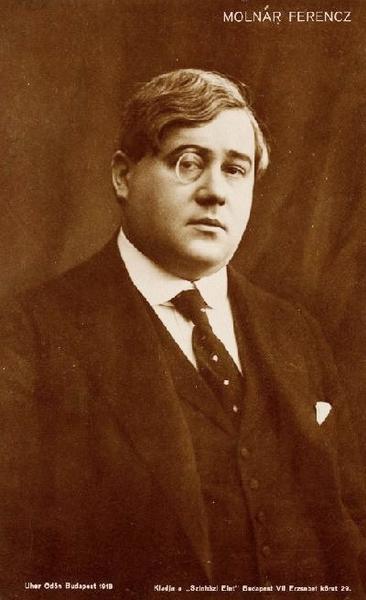
He worked at night, often in the gallery of the New York Café. He held nothing back in his turbulent love life: he would strike out, then apologise to his wife through a play – although he gave the lead role to his mistress, with whom he had even fought a duel against his husband. He had his fair share of failures and disappointments, whilst at the same time being regarded as a celebrated author both at home and abroad.
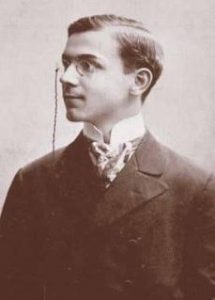
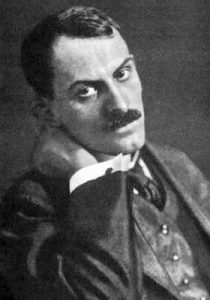
Ferenc Molnár was born on 12 January 1878 in Budapest as Ferenc Neumann into a Jewish family of German origin; his father was a doctor. Following his law studies in Geneva, in 1897 he became a journalist and a regular contributor to the *Budapesti Napló*, *A Hét*, the *Est* newspapers and the *Pesti Hírlap*. After his first play, *The Doctor*, was premiered in 1902, he produced a new play almost every year. His play *The Devil* also featured elements of Freudian psychology – a concept that was now gaining acceptance worldwide. This was the first Hungarian play suitable for export; nine months after its premiere, it was already being performed in Turin. Molnár’s plays were subsequently staged in Vienna, Berlin, London, Paris and America.
Ferenc Molnár was a prolific writer, though the public were eagerly awaiting a new, significant masterpiece. It was at this time that a newspaper reporter tried to visit him. The young man rang the doorbell at Molnár’s flat around midday, and a dishevelled maid finally appeared in the doorway, informing him that Mr Molnár was still asleep. She then added that it wasn’t worth waiting for him, because once he woke up and got himself ready, he would go to the New York Café, then on to the Fészek Club, and wouldn’t be home until dawn. The reporter asked: „And when does Ferenc Molnár write? At this, the writer replied grumpily, appearing in his dressing gown: ”Mr Molnár never writes. Mr Molnár creates.„
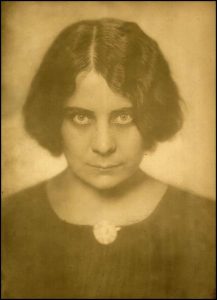
Molnár kept rooms in five hotels abroad and was married three times. He beat his first wife, Margit Vészi, who was a writer and painter, on several occasions. On one occasion, he struck her in public because he could not cope with her independent behaviour. According to his contemporaries, he was aggressive and an alcoholic, which was one of the reasons his wife left him. Molnár wrote the play *Liliom* specifically for her, in which the rough-and-ready man from City Park regularly beats his gentle, quiet wife, who supports him financially. The production was a huge flop at the Vígszínház in Pest in 1909; as a result, the writer suffered a nervous breakdown and was treated in a sanatorium for a year, though the same play was a great success in Berlin. Meanwhile, he fell in love with Irén Varsányi, who was playing the female lead at the Vígszínház. As she was married, a duel ensued, and Molnár was sent to prison. This was the last straw for his first wife, and she divorced him. As a result of these disappointments, he fell into a deep depression and attempted suicide.
When Sándor Bródy, who was also suffering from depression, tried to lecture him on the methods of suicide at the New York Café, Ferenc Molnár replied: “Uncle Sándor, please, when it comes to suicide, I’ll only take advice from someone who’s actually managed it.”
In 1940, he emigrated to the USA, and after his secretary and lover, Vanda Bartha, took her own life, the writer once again fell into a deep depression. Molnár, who had become increasingly embittered, died on 1 April 1952 whilst undergoing surgery for stomach cancer.
A masterpiece of young adult fiction, *The Boys of Pál Street* was first published in instalments in the 1905–1906 volume of *Tanulók Lapja*. “At that time, of course, I didn’t yet have a proper writing job, so I used to write the instalments each afternoon in the gallery of the artists’ café on the Grand Boulevard. The typesetter would come round in person to collect them and practically snatch the pages due that day right out of my hands. In any case, I liked working in the gallery because of the great silence; apart from the usual café hubbub and the ceaseless military band, nothing disturbed my work.” The work, which was published in book form a year later, has been translated into countless languages, and the Hungarian-American co-production film based on it, directed by Zoltán Fábri, was nominated for an Oscar. In 2005, the novel was voted Hungary’s second favourite book in a television poll entitled *The Great Book*.
According to one legend, on the day the New York Café opened, it was Ferenc Molnár who, together with his playful, bohemian journalist friends, threw the café’s keys into the Danube so that it would remain open day and night. Whether the story is true or not, whether it actually happened or not, we still do not know for certain today, not least because Ferenc Molnár was barely sixteen years old in 1896 – yet the legend stubbornly persists that it was his idea. It is a fact that Molnár was passionate about New York.