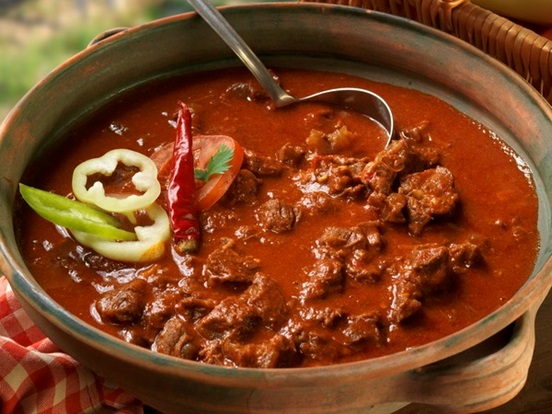
There are countless legends surrounding beef goulash, but one thing is certain: it is a true Hungarian speciality. The biggest misconception, however, centres on its origins; yet its centuries-long popularity is undeniable, and it is as much a part of Hungarian culture as the Puli dog.
Beef goulash
Join the New York Café team in Budapest. Opportunities in hospitality, the kitchen, patisserie, front-of-house and internships at the world’s most beautiful café.
Goulash or stew
Goulash soup is a distant relative of „real” goulash; the way it is prepared is more similar to paprikás or pörkölt. Nowadays, when someone makes goulash soup at home, they describe it as a base of braised meat, topped up with water and supplemented with vegetables and root vegetables.
As beef was expensive, the basic method of preparation was adopted from shepherds, but its further development and refinement into its final form took place in the 19th century, in middle-class kitchens. It was already mentioned as a soldier’s dish in 1793, and from 1886 onwards it appeared regularly in the entries of the Academy’s Comprehensive Dictionary. In the meantime, the term ‘gulyás’ came to be understood increasingly as ‘gulyás soup’.
A symbol of resistance
The emergence of goulash – along with pörkölt and paprikás – as a national dish was closely linked to the reform efforts of Joseph II. As the monarch wished to integrate Hungary into a unified imperial administrative system shared with Austria and Bohemia, the nobility chose distinctive symbols to express their resistance. Alongside the defence of the Hungarian language and the revival of traditional Hungarian dress, they found in a simple shepherd’s dish from the Great Plain the very food that emphasised the unity and distinct character of the Hungarian people. Goulash was regarded as a quintessentially Hungarian dish, as it originated from a part of the Great Plain that had been least affected by the „Germanisation” so characteristic of Transdanubia. Such a dish would scarcely have been found on the tables of the Hungarian nobility before this time.
It was from this time onwards that goulash became a popular dish. In the 1800s, the name was included in dictionaries; in the 1810s, recipes for it appeared in cookbooks; and in the 1820s, it featured on the menus of provincial and town restaurants. In the 1830s, it was listed among the national characteristics of Hungary in an academic treatise, and in the 1840s, „pörkölt hús” also appeared on the menus of restaurants in central Pest. And finally, paprika-based dishes secured a firm place for themselves in middle-class cuisine.
Not suitable for ladies
At our café, teamwork, reliability and a commitment to the guest experience are our core values. At New York Café, every role plays a part in ensuring that guests not only visit us, but also leave with a memorable experience.