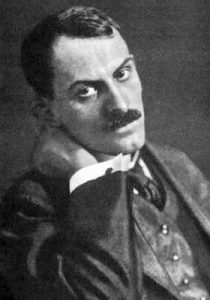
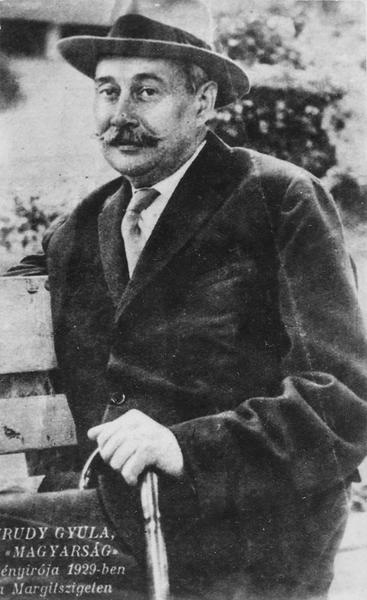
The writer and poet’s prolific output is astonishing; thousands of writings, novels, sketches and short stories have flowed from his pen. To this day, no one can understand how he found the time for all this, given that he constantly spent his time in small pubs, cafés and restaurants. He worked tirelessly; legends circulated about his physical strength, his appetite for love, his passion for the culinary arts and fine wines, and his unrestrained revelry. He had experienced wealth, yet he died in near-poverty in 1933.
Thanks to his parents„ very different social backgrounds, Krúdy was familiar with both the world of poverty and that of wealth, and this left its mark on his literary work. He inherited his vivid imagination from his mother, and perhaps even more so from his grandmother, Mária Radics; his bohemian streak certainly stemmed from his grandfather, a veteran of the 1848 Hungarian Revolution and a legendary womaniser. His father was a lawyer who led a sober life and brought up his children with strictness but also with love. He would have liked to see his son follow in his footsteps, and could never quite come to terms with the fact that his son had become a writer. His grandmother was a sort of 19th-century esoteric jack-of-all-trades; she practised the high art of dream interpretation, palmistry, healing and quackery, and Krúdy published her dream interpretations in his book on dreams.
He was born on 21 October 1878 in Nyíregyháza. He was not yet twenty when his first collection of short stories (*The Nest Is Empty and Other Stories*) was published. He was a contributor to numerous periodicals, including *Nyugat*. The *Sinbad* series and his novel *The Red Post Coach*, published in 1913, brought him national fame and genuine popular success.
Gyula Krúdy frequented almost every restaurant and café in the capital; he was just as much at home at the New York or Gundel as he was in the small pubs of Óbuda. For Krúdy, with his distinctive voice and lifestyle, even a simple stew was a feast. It remains an eternal mystery how, amidst his turbulent life, he managed to write more than fifty novels, some three thousand short stories, and several thousand articles, sketches and seven plays. He adored women (including his wives) and his children, and harboured a nostalgic longing for a quiet life, but this remained merely a wish. He was captivated by an insatiable craving for delicacies, eating and drinking, social life, card games and literature.
According to historian Noémi Saly, seventy identifiable business names can be found in the pages of Krúdy’s works, from Kőbánya to Óbuda, and from the outer Kerepesi Road to Krisztinaváros. It is all too easy to pigeonhole Krúdy as a chronicler of small pubs and taverns – yet he paints by no means as distinctive a picture of these as he does of the coffee houses. In the former, it is mainly the eating and drinking that matter; in the latter, however, it is the place itself that is of interest – with its patrons, the barista and the waiters. It is true that, unlike many of his contemporaries, Krúdy neither lived nor wrote in coffee houses, yet he still provides a comprehensive overview of them.
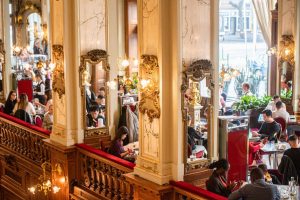
Countless recollections have been written about the New York Café, but what Krúdy writes about it does not paint a particularly favourable picture. If there was one thing he detested, it was the pretentious pomp, the noise and the showiness. There was, however, one person whom Krúdy certainly held in genuine affection: Gyula Reisz, the most distinguished literary maître d” of all time, who „calculated down to the last detail just how much credit he could grant to which young writer, who would go on to make something of themselves out there in the world, and who would remain here, stuck in some backwater, helpless and unproductive… But the main thing is that every young writer was granted a certain amount of credit; they did not have to wander the streets at night without shelter if they happened to have a falling-out with their landlady: many slept in the café’s private rooms during stormy days…”
The historian also recounted a morbid yet elegant prank that Krúdy played with Gyula Reisz:
After a night of card-playing that had resulted in a crushing loss, four young journalists popped into the „Nyehó” with Krúdy, who ordered breakfast for all of them; Mr Reisz, however, was only willing to put it on credit for him. Krúdy set off towards the telephone box with dignified composure… It was perhaps not even a quarter of an hour before a huge cart pulled up in front of the New York’s wide-open windows. On the cart were ornate and less ornate coffins, which three burly lads carried into the café with dizzying speed. The early-morning patrons choked on their food in horror. Uncle Reisz, the landlord and the waiters in their white coats rushed desperately towards the coffin bearers:
„Have you gone mad? What on earth were you thinking? Bringing coffins here? Take them back at once!”
‘To hell with it,’ replied the lads, ‘we’re just glad to have unloaded them… They’ve been ordered here, so they’re staying here, end of story.’
‘What do you mean, “ordered here”? Who ordered them here?’
– The honourable writer, Mr Gyula Krúdy.
Uncle Reisz rushed over, and the whole army of waiters threw themselves head over heels at Uncle Gyula’s feet, who sat motionless in his seat. They pleaded in unison:
– Dear master… Take the coffins away… Don’t ruin the café…
Uncle Gyula pointed at us with a single, sluggish gesture: – Will there be breakfast?
Mr Reisz ordered, loudly and briskly, in a commanding tone we’d never heard before… from the quietest diplomat in the cafés of Pest. Not one, but three waiters came running with breakfast: frothy coffee for the four of us, butter, jam, ham, salami, rolls, white bread… Uncle Gyula had beer for breakfast, beef goulash reheated from the previous evening, green peppers, rye bread, followed by a glass of black coffee with water.
Uncle Reisz didn’t even have to ask. Krúdy beckoned to the three lads and called the coachman in as well:
‘Thank you, lads,’ he said. ‘Mr Reisz will pay for the fare and the tip – five crowns each. Now go on, God be with you.’
He shook hands with each of them, then tilted his head to one side, resting it in his palm, and closed his eyes… Perhaps Sinbad was now setting off on a new journey… We were wrong. Uncle Gyula suddenly shouted:
‘I’ll pay!’
We couldn’t believe our ears; Uncle Reisz nearly collapsed from the shock. It wasn’t the volume of the shout that surprised him, but rather its content… and the large pile of crumpled banknotes that had been taken from Krúdy’s pocket and placed on the marble table. Ashamed, he handed the bill to Krúdy. Uncle Gyula glanced at the note and handed it back:
‘I said the whole lot! Every last penny, including the old debt the lads owe.’
Uncle Reisz settled down at the neighbouring table, dug out the old receipts, and after half an hour of calculations, somewhat flustered and very humbly, handed over the final bill. Krúdy swept the whole pile of money towards Uncle Reisz with a single sweep of his hand:
– The rest is yours and the waiters’.
He smiled sleepily at me, slowly got to his feet, and set off towards the exit with sluggish steps. Then he suddenly stopped and came back to our table:
‘Doesn’t any of you happen to have two crowns?’ he asked. ‘I need them for a tram.’
It was at the New York Café that the common term ‘Főúr’ first came into use: in 1902, the Harsányi brothers, out of a sort of philanthropic goodwill, took on a down-and-out aristocrat, Ernő Walburg, whom the guests then addressed, half in jest and half with the respect due to his rank, as they called him over to the table with the cry, ‘My Lord, I’ll pay!’.