These days, so many of us find ourselves in unbalanced life situations – whether we’re single, have suffered losses, or are struggling to come to terms with our emotional wounds. How can we change all this, and how can we make our lives – and our relationships with those around us – better?
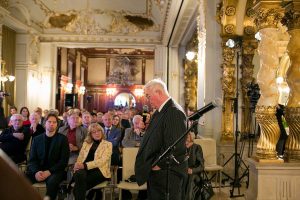
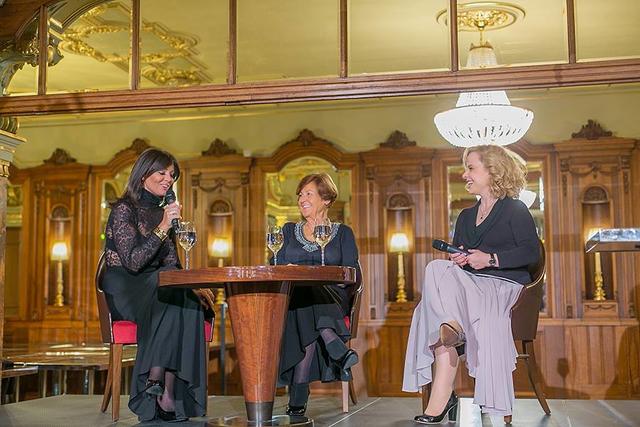
Professor Dr Emőke Bagdy, and her daughter, Dr Noémi Császár, honoured our café with their presence and were also our guests at our ‘Artists’ Circle’ lecture series, after which we chatted over a glass of champagne about life’s difficulties and possible ways of overcoming them.
The New Year has dawned, marking the start of a new chapter, yet we are still carrying our pain, our grievances and our wounds with us. How should we approach the New Year and the future that lies ahead?
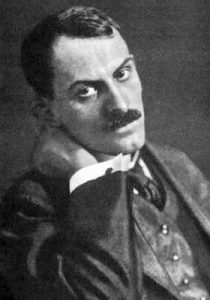
Emőke: New York Művész Páholy – Sándor Bródy – the charming soul of the company – New York Café After all, when we pay attention to others, we are not focusing on ourselves and our problems, and this puts an end to our self-absorption. It is a fact that when we are in pain or have a problem, we start to focus on ourselves. We become narcissistic. This is the so-called process of self-love and self-indulgence. (When we have a toothache, for example, our tongue is constantly touching the affected tooth. But why, when it makes no sense at all?) We need to stop focusing on ourselves and breaking out of our narrow-mindedness. New York Művész Páholy – Sándor Bródy – the charming soul of the company
Noémi: New York Művész Páholy – Jenő Heltai – who regarded the New York Café as his home – New York Café
How can we avoid or change this sort of attitude within ourselves?
Noémi: New York Művész Páholy – Jenő Heltai – who regarded the New York Café as his home I may be here now, alone and feeling abandoned, bringing up my child on my own, but this is MY life. Unique, unrivalled, one-of-a-kind. Just as my own child is unique, one of a kind and irreplaceable.
If I had to take the place of anyone else, even for just a day or an hour, it is by no means certain that my assessment would be any more positive.
Another suggestion from psychology for such situations is the ability to feel gratitude. Do we give thanks for being here in this world?! After all, we’ve done nothing to deserve it… Our very existence is a gift we’ve been given by someone, for a time, and it is only right to accept that gift with joy, because the one who gave it did so out of love. He could have given it to someone else, but we were the ones who got a share of the billion.
Gratitude can go a long way in situations like this! Let’s not focus on all the things we can’t be happy about. Let’s focus on all the things we can be happy about, and Let us be glad for what we have, and let us give thanks for it, for this gratitude will come back to us!
Emőke: Gratitude has become a key concept in the psychology of happiness. There is a philosopher called Simone Weil, who was Pilinszky’s favourite philosopher. She said that there is a very important sentence on which we should all reflect: „Let’s learn to long for what is already ours!”
However, it often happens in life that, even though we know we ought to be grateful, we are unable to show this to others because of our anger or past grievances. How can we change this?
Noémi: Anger, loss and guilt are like twins. Triplets. Consequently, when we feel anger, we have in fact experienced some kind of loss, and this stirs up anger towards ourselves, and of course the resulting guilt as well. So at such times, we approach things with this trio of emotions, the root of which is loss.
At such times, the most important thing is to be able to quiet our minds a little. Even if only for half an hour! Let’s practise meditation and reflect on what it is about this loss that we most want to understand, accept and, above all, make part of the story that is our personal life. Because once this loss has found its rightful place within us, we no longer need to be angry about it, nor do we need to find someone to blame – be it our partner, our child or our parents – but we can experience the miracle of who we are.
At the same time, losses are a necessary part of life. We experience what are known as ‘normative losses’. This means, for example, that when we are born, we lose the womb. When we are separated from our mother as we go to the crèche or nursery, we lose her embracing arms. Not forever, but to some extent irreversibly. Every stage of development involves a loss. Consequently, it is a crisis in which we must let go of something in order to grasp something new. If I’m clutching something in my hand, I can’t hold on to anything else. That’s what our losses are like.
New York Művész Páholy – Jenő Kálmán – who never lost his sense of humour – New York Café
All this seems so obvious, and yet we find it so difficult to cope with crises and painful changes throughout our lives. Why is that?
Emőke: The sin of our culture today is that it teaches us to keep the human soul in a state of perpetual infancy. For it tells us: ’Make yourself happy, because you deserve it! Look after yourself and no one else!„ And in doing so, it preserves a state of being that is very childish. For a child wants to receive, and has a right to do so, since it is their parents who provide for them.
”Give me nourishment, protection, security!’ – and this does last for a certain time – until around the age of 20 – as we go through the normative life crises. By then, we come to accept it: all right, I’m entitled to it, I’ll get it, and I can even ask for it, because this is the condition for me to stock up on everything – the ‘ammunition’ – so that I, in turn, can give it to others later. After all, this is how I’ll become an adult!
Ericson, a world-renowned psychotherapist, said that three things are needed to become an adult. I am only an adult if I can make a commitment, take on responsibility and give. What? From myself, what I have been given. From my abilities, the service of my vocation; from my capacity for love, the continuation of the family, the continuation of life.
There is no such thing as life having no meaning. It has a central meaning! If you are a woman, then, for example, you give birth to children and carry on the cycle of life. If you are a man, you create and build, because that is how you are biologically wired, and because you are capable of fathering children. You can create, build a house, plant a tree. The man is the bearer of the creative principle, whilst the woman is the creative, nurturing and realising principle. For us women, all our abilities – and indeed our physical constitution – point to the fact that we should use these to bring children into the world, if at all possible. This is the central meaning of life! Once a person discovers the creative purpose of their life, their life is already on the right track! It is a difficult, labour-intensive task, but it is worth it.