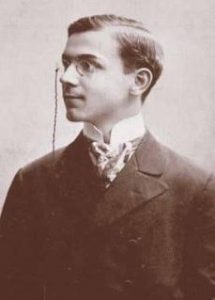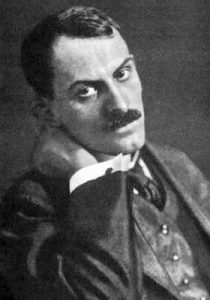
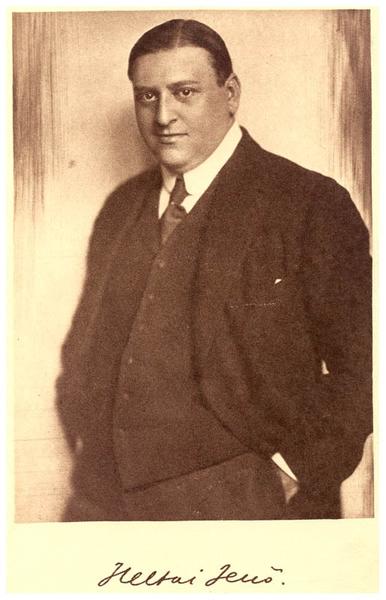
The writer, poet, journalist, producer and dramaturg Jenő Heltai was just 23 years old when the New York Café opened on 23 October 1894. After returning from Paris, where he had been a correspondent for several newspapers, he quickly became a regular, feeling right at home in the café’s atmosphere.
Grant information – New York Café I was a shy, timid and clumsy lad; at first they saw no use for me, and by the third week they were planning to sack me. This disheartened me so much that I resolved to do something terrible: I decided to become a comedian.Grant information
„In the splendour of New York, they cleaned your shoes, ironed your clothes, gave you a shave even late at night, and trimmed your hair and nails… The café served as a workshop and a desk; in times of misfortune, it was also a flat and a place to sleep, as there was no need to leave it from dawn till dawn.”
To quote Jenő Heltai – the greatest thing was that „Despite all its New York glamour, it was a democratic café, attracting aristocrats, the middle classes and the bohemians, just as, on summer evenings, the dazzling tram lamp gathers round it, with unchanging indifference, all manner of moths and beetles wandering aimlessly in every direction. No one could resist its magic…”
His outspokenness was legendary. He was full of vigour, conviction and ideas. This is how he wrote about that period: „We, immature, ill-mannered lads: Ignotus, Emil Makai and I simply cheekily butted in on the distinguished, noble verses of József Kiss, Reviczky, Komjáthy, Sándor Endrődi, Károly Szász, József Lévay and Lőrinc Tóth… We were already the children of a new world. Simpler, more natural, less lofty than they were; the new things they had brought had already become outdated for us.”
Until he got married, he had been in love with hundreds of women; during the last 34 years of his life, however, he was in love with just one. Yet whilst he was living the life of an independent young man, he got up to all sorts of things. According to one story, one night as he was leaving the New York Café, a night butterfly approached him, put her arm round him, and told him that there was a police raid on, and if a detective came to check his identity, he should tell the policeman that she was his fiancée. „Sure enough, after a few steps, a detective appeared and asked for the girl’s papers. To which I replied: „Inspector, this lady is my fiancée.” The officer saluted and left. A short while later, he pulled me aside and whispered in my ear: „Mr Writer, don’t marry her!””
During the First World War, he spent a considerable amount of time in Istanbul as a war correspondent; after the war, he served as president of the Hungarian Association of Playwrights and as director of the Athenaeum Publishing House. During the Second World War, he was forced to go into hiding and was even taken prisoner for a short time. In 1945, he was elected president of the Hungarian PEN Club; in 1949, he again spent a considerable amount of time abroad, primarily in London. His last fairy-tale play, *The Fairest of the Fair*, was premiered in 1955.
He was awarded the Kossuth Prize in 1957, but died on 3 September of that same year.