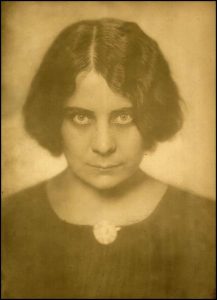
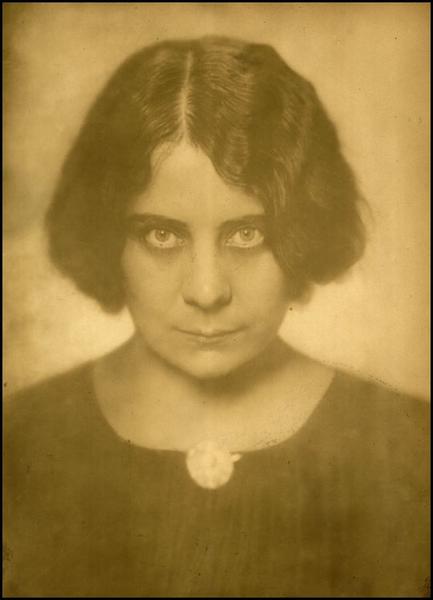
During her short life, she was one of the rising stars of a new generation in Hungarian literature; according to her contemporaries, she was exactly that: a WOMAN with a capital W. She created her works using simple, unpretentious words and phrases, yet produced true art. „My Margit, she is such a great talent that she no longer even counts as a woman,” said Endre Ady, who was himself a great admirer of the writer and poet’s vision and style of expression.
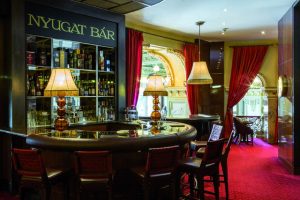
She was born on 10 June 1880 in Nagykároly. Although her father was a chief prosecutor, he died young, and so her family lived in modest circumstances. Her mother sent her daughter to study at the convent of the Sisters of Mercy in Szatmár. There she obtained a teaching qualification, after which she continued her studies in Budapest and, in 1902, obtained a qualification to teach at secondary schools from the Erzsébet Girls„ School. She moved to Miskolc, where she taught literature and economics at the girls” secondary school; her pupils adored her. It was here that her first writings – poems and short stories – were published, and it was around this time that she also became a regular contributor to *Nyugat*. During this period, thanks to Ernő Osvát’s ability to recognise talent and his consistency, numerous young authors were given the opportunity to be published alongside the established writers. The first generation included Ady, Babits, Kosztolányi, Árpád Tóth, Karinthy, Móricz, Géza Csáth and Margit Kaffka.
On 5 January 1905, she married Brúnó Fröhlich, a forestry engineer. Their son, László, was born the following year. In 1907, her husband was posted to the Ministry of Agriculture, so Kaffka was finally able to leave Miskolc, a place she had never particularly liked; and after they moved back to Pest and her marriage fell apart, she divorced her husband.
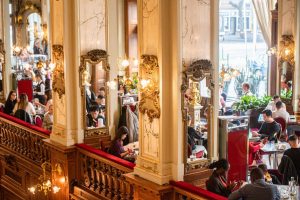
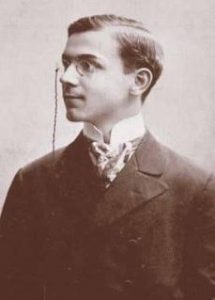
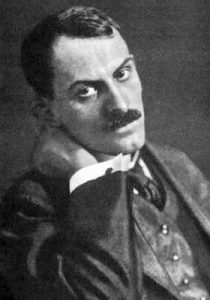
She was also close friends with Kosztolányi, Babits, Dezső Szabó and Béla Balázs. Her poetic world, her way of thinking and her views on literary policy were close to those of Ady, and over time this intellectual connection developed into a deep friendship. He gradually became involved in the internal affairs of *Nyugat*, in literature and literary life, and got to know the editors and fellow writers personally. She was a frequent figure on the literary scene; apart from editorial offices, her favourite haunts were the cafés. She also took part in the great nocturnal wanderings – mostly in the company of Dezső Szabó, Tersánszky or Ady.
Józsi Tersánszky writes of her as follows: “But one cannot imagine a more feminine woman, or a woman possessing more strangely feminine qualities, than Kaffka was. Vanity as the dominant trait, capriciousness and changeability – qualities that lend the fair sex an inscrutable character – were, in Kaffka’s case, somehow displayed in a shop window, ready-made and perfectly articulated. Kaffka immediately put even her most fleeting feelings into words. She justified and applied her sudden mood swings or retracted statements with the tightrope walk of the most exquisite sophistry, adapting them from situation to situation… so that she dazzled everyone with her intellectual sleight of hand.”
It was then that she became involved in a romantic relationship with Ernő Osvát, about whom she wrote in *Stations*: “It began as a beautiful, grand, true love; it degenerated into a commonplace, fleeting affair.” It was during this turbulent period that her two most significant novels, *Colours and Years* and *Mária’s Years*, were written. She worked as a teacher in the capital between 1910 and 1915; meanwhile, in 1914, she remarried in Szeged, this time to Ervin Bauer, a theoretical biologist and brother of Béla Balázs. At the outbreak of the First World War, she gave up teaching and devoted herself entirely to fiction. The war horrified her; she gave voice to her feelings in poems that were initially pacifist but became increasingly revolutionary. In 1915, her husband was posted to a hospital in Timișoara; from then on, Kaffka commuted between Budapest and Timișoara. Meanwhile, she wrote another novel, *Hangyaboly* (*Anthill*), in which she recounted her childhood years spent in a convent.
In the final period of her life, her work as a journalist also came into its own, with most of her writings being published in the *Pesti Napló*. In 1918, several of her volumes were published, and she was admitted as a member of the Vörösmarty Academy. At the end of November, Kaffka and her son both fell ill with the Spanish flu, which was sweeping across Europe. She was taken to hospital, where she died on 1 December 1918; her son survived her by just one day.