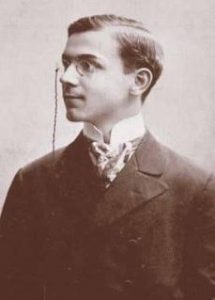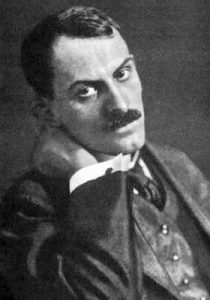
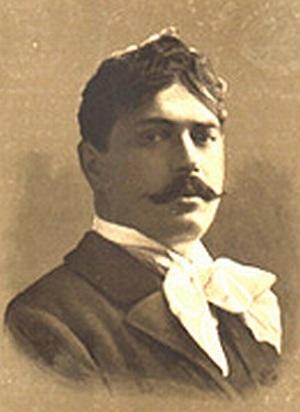
Nor did this passionate Hungarian writer, playwright and journalist belong to the circle of reserved men. Through both his works and his personality, the „Hungarian Zola” influenced, amongst others, Endre Ady, Zsigmond Móricz, Gyula Krúdy, Dezső Szomory and Ferenc Molnár.
He intended to become a village schoolteacher, but never completed his studies. He managed to make up for his lack of formal education with his extraordinary talent. At the age of 18, he began working as a clerk for his elder brother, who was a solicitor in Gyula. It was here that he managed to have his first articles published in the local newspaper. He was greatly influenced by Jókai’s effusive storytelling and Zola’s naturalism. After moving to Budapest in 1884, he succeeded in publishing his collection of short stories *Nyomor* and his novel *Faust, the Doctor*, both of which caused quite a stir.
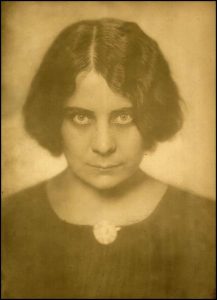
He was a man of passionate nature. The handsome Bródy seduced Margit Hunyady, a well-known actress of her time, shortly after arriving in Kolozsvár. The relationship soon produced an illegitimate son, Sándor Hunyady, who was his favourite; he too would later embark on a literary career. By this time, he was already married to Judit Fehér. He left his family in Budapest but continued to support them financially.
Between 1903 and 1905, with the collaboration of Zoltán Ambrus and Géza Gárdonyi, he edited the weekly newspaper *Jövendő*, which was the forerunner of *Nyugat*. In it, he criticised the injustices of contemporary society. Meanwhile, he was having an affair with the writer Renée Erdős. Bródy, who lived his emotions with great passion, attempted suicide in Semmering in the summer of 1905. After recovering, he returned to journalism, working for the *Pesti Hírlap*, the *Nap*, the *Ujság* and *Az Est*. Although he sympathised with the Hungarian Soviet Republic, he did not play an active role in it. Nevertheless, during the counter-revolution, he was forced into exile in Vienna.
He was combative and witty, brimming with ideas. He was the life and soul of the social circles of his time, and he also dictated literary fashion.
He returned to Hungary in 1923. He suddenly found himself alone, but was in a precarious financial position. He still managed to write his last major work, a cycle of short stories about Rembrandt, the lonely, ageing artist. He was subsequently admitted to hospital and passed away.
Passion characterised everything he did. This was evident not only in his relationships and lifestyle, but also in his enthusiasm for food.
In response to Ignotus’s famous recipe competition, Bródy described the goulash, one of his favourites, as follows: “This is our main dish, for those of us who live in this nation-state, whether as descendants of the hero Árpád or of David the Sling-bearer. A good, hearty, paprika-spiced stew – for ever! All political parties are united in this belief. There are no differences of opinion, taste or interest here. Bánffy believes in goulash, as does Hock, and I very much fear that Apponyi has not become more than he is simply because he did not believe strongly and sincerely enough in goulash – the real thing. Take Gyula Andrássy, for instance: he was merely brought up in high society, and I have just heard from his former cook – who is now head chef at the restaurant on Margaret Island – that, of all dishes, the count held goulash in the highest regard. You, goulash, best reflect our national character and our climatic conditions! But you must indeed be well-braised; do not be pale, wan or light in colour. You must be a deep brown, and the gravy beneath you must be neither too thick nor too thin, nor watery. And if you are made from boneless veal, a little finely minced beef—almost like a meatloaf—should be added to strengthen your gravy; if possible, use tough, well-coloured chuck.”
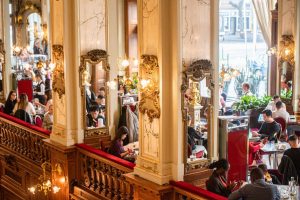
In his work *Portraits of Writers*, Gyula Krúdy painted a very sharp portrait of his fellow writer, who took his seat at the table in front of the till at the famous literary café, the New York: „Sándor Bródy shines, struts and flatters at the table in front of the till at the New York café; he stirs up trouble, and his favourite catchphrase—that he never reads newspapers—is often heard. This was just as much a writer’s exaggeration as his claim that he never writes in cafés! He didn’t write; rather, he worked!”… and at times he would shower the author of a police report with such praise that you would never forget it for the rest of your life, at other times he offers two or three-word critiques to the author of a new book that has been launched with great fanfare and much pomp, which the honoured gentleman will likewise recall to himself for the rest of his life, albeit through gritted teeth.”