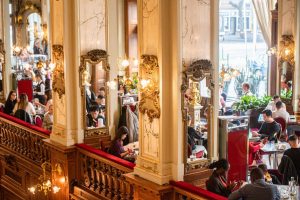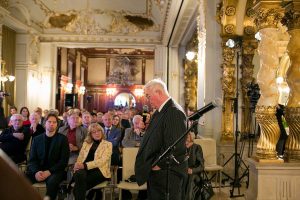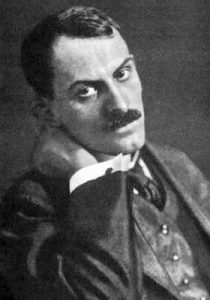
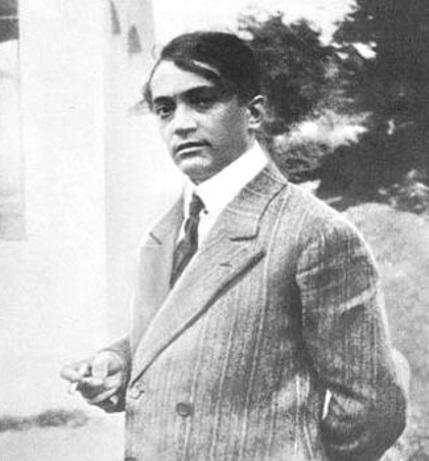
„Kávéházi Borzas” was Endre Ady’s nickname in coffee houses around 1910. From this, we can surmise that one of the most significant poets of the 20th century, and one of the greatest figures in Hungarian political journalism, spent a fair amount of time in coffee houses. Among other places, he took his seat at the editorial table of the *Nyugat* on the gallery of the New York Café, having been a contributor to that publication himself.
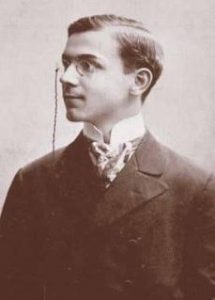
He was born on 22 November 1877 in Érmindszent, in what is now Romania, as the middle child of an impoverished noble family. Ady came into the world with physical characteristics that differed from those of the average person. He had six fingers on each hand, but these were removed by the midwife. The poet later regarded his extra fingers as a sign of his chosen status, and this came to be shrouded in mystery in the public eye. In addition, he was born with ears that protruded on both sides and strikingly large, short-sighted eyes. As an adult, out of vanity, he refused to wear spectacles, preferring instead to lean in very close when reading. His legs were naturally spindly and weak; this may have accounted for his unsteady gait, and his large bunions forced him to wear special shoes. He grew physically stronger during his secondary school years; it was at this time that he also wrote his first poems, which were mostly satirical verses.
His more active social life and drinking began in the 1890s, whilst he was a student at the Reformed College in Zilah. The school had a liberal ethos; smoking cigarettes in public was permitted there, and Saturday-evening pub-hopping also became a regular feature; it was here that his first literary successes were recognised, and his first romantic experiences took place. Erzsike F. later became the ”Zsóka„ of his works.
He then studied in Debrecen and subsequently at the Faculty of Law in Pest, though he did not truly appreciate the support of his impoverished parents: the tuition fees they sent him on several occasions were squandered on drinking binges. She graduated from university in 1899, by which time her first collection, entitled *Versek* (*Poems*), had been published, though it was not a success. She spent time in Debrecen and also worked for various newspapers in Nagyvárad. In Nagyvárad, he led a bohemian nightlife, and it was in this city that he became involved in the fateful love affair which led to his first contraction of syphilis: he wrote about this in his short story *Rozália Mihályi’s Kiss*.
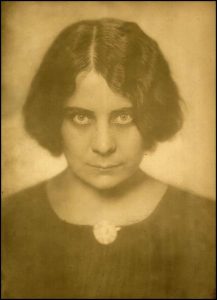
In 1903, he fell head over heels in love with a wealthy married woman who had moved from Oradea to Paris, Adél Brüll, née Diósy. She appears in his works as ”Lédá„ and became his muse. He visited her several times in Paris; this love affair and the French capital had a profound influence on the development of his poetry. The relationship with Léda lasted nine years: from 1903 to 1912. Ady finally broke up with Léda for good with his poem ”Elbocsátó szép üzenet“ (”A Beautiful Farewell Message’), published in *Nyugat*.
In 1908, Ady’s poems and essays appeared in the first issue of the new literary journal *Nyugat*; he remained a contributor to this journal until the end of his life, and from 1912 onwards he was also one of its editors. In 1908, in Nagyvárad, he was one of the founders of a literary group called A Holnap. Antal Szerb wrote of him that Ady was first and foremost a good journalist rather than a good poet, and that he retained his journalistic nature throughout his life.
Following his stormy break-up with Léda, Ady’s self-destructive behaviour became even more pronounced than before. It was not just a matter of ‘little women’s shoes’, as the title of one of his poems suggests, but of the 4–5 litres of wine a day, the 4–5 packets of cigarettes and the morphine to which he had become addicted by this time.
“Wine has two kinds of intoxication… The first is like anyone’s: it stirs up within us every eternal impulse, and we feel immensely powerful. Then comes the sleep at the end of the night, at dawn, with many strange awakenings… And when dusk falls, all of a sudden, wherever we may be, our restless minds and hearts—which remain restless—are enveloped by the universe. This is quite an artistic sensation… I emphasise that this comes the following evening: the height of human sensitivity, this one or two hours that reveal even the greatest secrets. This has nothing to do with alcohol intoxication or intoxication; it is a perverse conjuring trick of the nerves.” (Ady)
He was constantly short of money; to put it mildly, without the support of Count Lajos Hatvany, one of the founding editors of *Nyugat*, he could not even get drunk. The count is, incidentally, also referred to as ‘the last patron’, as he was perhaps the best-known supporter of Hungarian literature. Although he did not invest any more money directly in *Nyugat* following his conflict with Ernő Osvát, he continued to support writers in need, alongside Miksa Fenyő. They helped almost every Hungarian artist of the time: Hatvany paid for Ady’s convalescence at the Maria-Grün sanatorium. Hatvany also put his literary work at the service of literature: through his reviews, he helped to promote the writers he had discovered, and, in addition to Ady, he wrote a monograph on Petőfi.
From 1914, another woman came to define Ady’s emotional life: it was then that he met the then 20-year-old Berta Boncza, with whom he had been corresponding since 1911. On 27 March 1915, they married without the girl’s father’s consent. In his poems, he referred to Berta as ‘Csinszka’.
‘Ady found it hard to bear when things were not all about him. Even good or bad news would affect his health… At home, the public adored him, whilst the literary world was less kind to Ferenc Molnár. Endre Nagy recorded the incident when Endre Ady fell ill, on the very day of the 1916 premiere of Molnár’s *The White Cloud*. Ady really was in a terrible state. He was retching, groaning and shaking… – recalled Endre Nagy, who had visited him and told the sick, delirious poet about the premiere. He comforted him thus: ‘You know, Bandi, it wasn’t just you who had a bad night; poor Ferenc Molnár did too, as his new play was a bit of a flop at the Vígszínház.” At that, Ady sat up straight in bed. “Oh, really?” he asked with a broad smile.” (Cultura Magazine)
In November 1918, he suffered a minor stroke as a complication of tertiary syphilis. From then on, his speech became slurred, but his mind remained clear. Later, he contracted the Spanish flu, which was sweeping across the world at that very time; the resulting pneumonia, accompanied by a high fever, was treated at the Liget Sanatorium. He had been in hospital for two weeks when he died suddenly on 27 January 1919. According to the medical geneticist Dr Endre Czeizel, based on the post-mortem examination, his death was caused by a rupture of the aorta.
His funeral took place on 29 January: his coffin was laid in state in the foyer of the Hungarian National Museum, where, alongside public figures, several thousand people paid their respects and bid him farewell, before accompanying him on his final journey, bareheaded, along Múzeum körút and Rákóczi út to Kerepesi Cemetery.
Zsigmond Móricz wrote the following about Ady:
“Endre Ady was, first and foremost, an extraordinary individual: he possessed that quality, more precious than anything else, which only a few beautiful and enchanting women possess: the ability, without doing anything at all, to immediately draw every eye and every heart to himself: there was something of unprecedented charm, optimism and fervour within him. He was brimming with a marvellous zest for life, which radiated from him and glowed; and those around him felt, as if enveloped in an aura, that their own abilities were heightened, and they marvelled at themselves, admiring just how clever, correct, witty, so broad-minded, and possessed of such a profound philosophy of life in the presence of Endre Ady: they did not recognise themselves; even long after they had forgotten the words they had heard and spoken, they would always look back on those moments as a marvellous, wonderful feeling, the very memory of which still brings a sweet smile… No one will ever be able to take this miracle away from Endre Ady: this unheard-of magic of affirming life… Endre Ady lived by the artistic principle – more intensely than anyone else – that every feeling and seed of thought in life exists solely for the artist to transform, through hard work, into artistic value…”