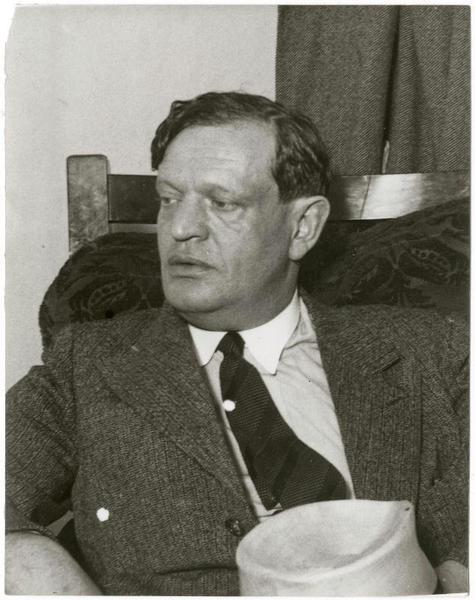
When it came to humour, he had no sense of fun. He loved playing cards, laughing and bantering, yet he was a deeply emotional and sensitive man. He was constantly late – from almost everywhere, for almost everything – yet his writings were dead on the mark. Most of them were conceived at the marble tables of the New York Café.
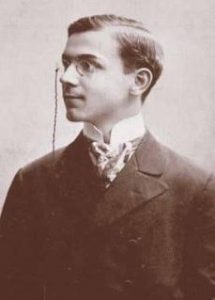
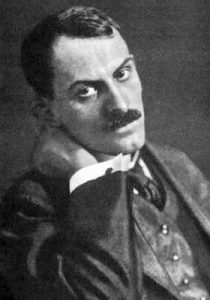
Frigyes Karinthy was a Hungarian writer, poet and literary translator. He was born on 25 June 1887 into a middle-class family with many children in Budapest. His father was a friend of poets and philosophers and a founding member of the Hungarian Philosophical Society; for the young Karinthy, this vibrant intellectual milieu and the atmosphere of artistic, literary and philosophical debates came naturally.
He began writing between 1898 and 1900: plays, adventure stories and verse tales; he also kept a diary. Around a thousand of his poems and 10–15 of his longer early works were burnt by his father because he had failed at school. He was fifteen years old when the magazine *Magyar Képes Világ* published his novel *Honeymoon Journey through the Centre of the Earth* in instalments.
In 1905, he passed his school-leaving examinations, after which he simultaneously began studying the humanities, medicine and the natural sciences, but never obtained a degree. He was fascinated by developments in science and technology, film and radio, and even tried his hand at flying aeroplanes and airships.
From 1908, he was a contributor to *Nyugat*. Although Endre Ady, the journal’s most prominent author, followed his every move with a critical eye and made notes, he immediately recognised his significance in the history of culture. In 1912, two collections of short stories, two collections of humorous sketches, and *Így írtok ti* (This Is How You Write), a collection of literary parodies, were published simultaneously, making him famous and popular overnight.
*Így írtok ti*, a series of caricatures that had evolved from coffee-house games and the mockery of his contemporaries, gradually expanded into a deliberate encyclopaedia, not only completing a gallery of portraits of Hungarian authors, but also enriching the collection with themes from world literature and various literary genres. The secret of its enduring success lies in the fact that Karinthy sketched the entire character of the writers he targeted, creating a caricature of their creative style and mannerisms.
Writing chiefly for newspapers and periodicals (Nyugat, Magyar Írás, etc.), producing more than five thousand articles in his lifetime; these included reports, news features, travelogues, philosophical musings, literary analyses, reflections on the state of politics and a vast number of humorous sketches.
A lifelong friendship Karinthy had a friend whose personality was the polar opposite of his own: Dezső Kosztolányi. Although they bore no outward resemblance to one another, they were all the more alike in character: both were playful, possessed a boyishly adolescent demeanour, and were extremely sensitive. Their shared pranks and teasing are famous; for example, in Kosztolányi’s poem *Summer, Summer, Summer*, reading the first letters of each line together spells out: “Lick my arse, Karinthi”.
Following the outbreak of the First World War, he declared himself a pacifist; his novel *Journey to Faremido*, which draws on Swift, and his play *Tomorrow Morning* both contain anti-war themes. In his view, extreme dictatorships were manifestations of human stupidity and intellectual laziness. In his novels, humorous sketches and short stories, he developed traditional forms further in the direction of the grotesque, the absurd and black humour.
In 1936, he was diagnosed with a brain tumour and was operated on by the renowned Swedish professor Olivecrona. This “experience” gave rise to *Heavenly Report* and his novel *Journey Around My Skull*, which reflects on the brain surgery. After the operation, he drew up an ambitious five-year writing plan, but his strength only stretched to writing short pieces and sketches. Frigyes Karinthy died in Siófok on 29 August 1938.
He was famous for never keeping to agreed dates, set times, or deadlines for submitting manuscripts or articles. He was even a whole year out about his own age, always claiming to be a year younger. Kosztolányi once said: “I’m hurrying home because Karinthy promised to come round, and what if he’s forgotten that he promised, and actually does turn up.”
Miksa Bródy: The Polite Head Waiter
„At the New York Café, our friend Frigyes Karinthy ordered a roast. Shortly afterwards, Uncle Gyula himself, the head waiter, appeared with the piece of meat, which Karinthy eyed suspiciously for a while. Then, having speared the whole roast on his fork, he said with profound exasperation: ”Listen, Master Gyula, this roast is so thin and so translucent that you could read through it.’ Gyula replied politely: ‘What would you like to read, Mr Karinthy?’
*Winnie-the-Pooh* was published in Hungary in 1935 in Frigyes Karinthy’s humorous Hungarian translation.