
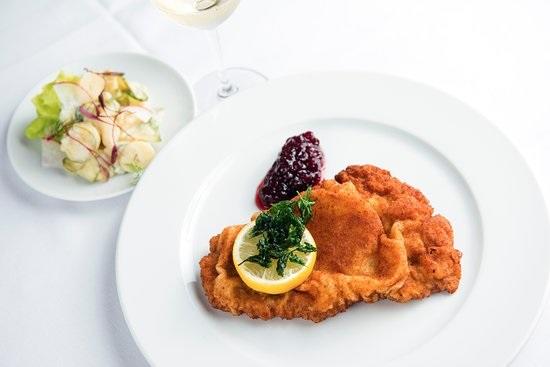
The Wiener schnitzel, this incredibly simple yet delicious dish, features on the menu of almost every restaurant. It’s easy to make at home too, although if you want to enjoy a genuine Wiener schnitzel, it’s worth sticking to the original recipe – because it can only be made from veal; if made from any other type of meat, it’s no longer a Wiener schnitzel, but simply breaded meat.
The Viennese cut – a truly international mix
According to legend, in 1857 Field Marshal Joseph Wenzel Radetzky told the Emperor about a delicacy he had eaten in Milan. The Emperor fancied the dish and ordered the head chef to prepare it for him. This led to the creation, in the Austrian capital, of the world-famous Viennese schnitzel – known in Hungary simply as „vínersnicli”.
However, breaded fried meat is not an Italian invention. The recipe already appeared in medieval Spanish cookbooks under the name chuleta andaluza. After the expulsion of the Moors in 1491, when Andalusia came under Christian rule, the local cuisine retained the traditional Arab method of preparing lamb, namely frying the meat until golden brown after coating it in flour, beaten eggs and breadcrumbs. ‘Gilding’ the meat was in vogue for a long time at the Byzantine court, where slices of meat were coated in real gold dust. The Moors spread the custom throughout Andalusia, from where it was adopted by the lavish courts of Italy.
However! Breaded meat is neither an Italian, nor a Spanish, nor even an Arab dish.
 Ancient evidence of breaded meat
Art and the café today
The authentic „Viennese schnitzel”
A breaded meat dish made from veal (veal loin, frikandelle, shoulder or thoroughly trimmed shoulder blade) that has been tenderised to a thickness of 3–4 millimetres. It is best served with a squeeze of lemon.
Ancient evidence of breaded meat
Art and the café today
The authentic „Viennese schnitzel”
A breaded meat dish made from veal (veal loin, frikandelle, shoulder or thoroughly trimmed shoulder blade) that has been tenderised to a thickness of 3–4 millimetres. It is best served with a squeeze of lemon.