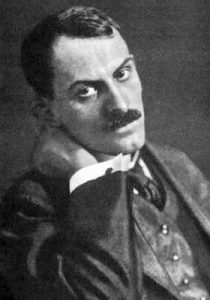
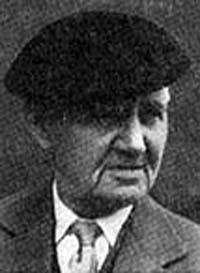
And yet he would have had every reason to. As a prisoner of war, he was held in Siberian camps, but even there he never gave up what mattered most to him: laughter, making people laugh, and the theatre.
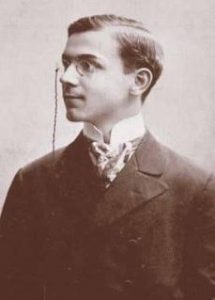
As a journalist and humourist, he lived in Budapest from 1905; his first job was at the newspaper *Független Magyarság*. He also contributed to the satirical magazine *Fidibusz*, edited by Adolf Ágai (known as Borsszem Jankó) and Jenő Heltai. He was also a contributor, assistant editor and columnist for the newspaper *Színházi Élet*, which was launched in 1911. He enlisted in the army in 1916 and was a prisoner of war in Nikolsk-Ussurisk until 1920, where he organised a Hungarian cabaret and theatre troupe, with which they performed in various Siberian camps.
On his return home, he resumed civilian life at *Színházi Élet*. In 1921–22, he served as secretary to Endre Nagy’s cabaret troupe, whilst also writing short sketches and couplets himself. He also wrote a novel based on his memories as a prisoner of war, and after 1945 his short pieces appeared in *Magyar Nemzet* and *Esti Hírlap*.
His best-known work, even amongst children, is The Adventures of Sicc, which was a series of verse tales and illustrated books in verse. The Sicc in Fairyland The film, entitled [title], was released in Hungary in 2002 as a 2D animated fairy tale. Throughout the story, Sicc travels through Fairyland, meets many well-known fairy-tale characters, and although he causes a bit of a ruckus, he always manages to get himself out of trouble.
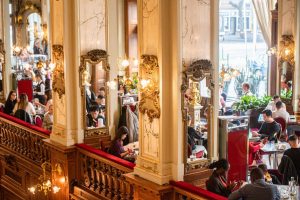
Although the main character in the book is a kitten, Jenő Kálmán had a dog. He took his Puli – which is also mentioned in his other works – everywhere with him, including the New York Café, where he used to have his daily lunch. As he didn’t want to leave his companion hungry, he arranged with the head chef that the dog would also be given lunch, for which he paid a monthly fee. Within a few days, the little dog learnt that whenever his owner sat down, he could head for the kitchen and his tummy would be filled. A few weeks later, Uncle Jenő had a falling-out with one of the waiters, so he switched to a nearby restaurant, where he continued the same routine: he arranged with the chef there too that the dog would get his share. Two months later, however, Jenő Kálmán was stopped in the street by the head chef of the New York, who accosted him, saying he hadn’t paid for the dog’s lunch for two months. Uncle Jenő protested that he hadn’t even been going there for two months. To which the head chef replied: ‘Uncle Jenő may not have been there, but the dog certainly has.’.